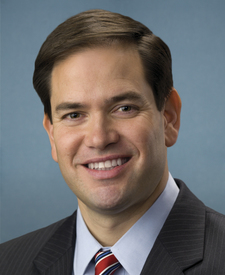
Marco Rubio
AnalysisR FL · Senate
Finance
-82Government Operations
+14Healthcare
-2Foreign Policy
-31Environment
-4Defense
-10Education
-88Transportation
-5Criminal Justice
+10Housing
-15Regulated Industries
-49Energy
-30Foreign Affairs
-43Technology
-30Trade
+13Environmental Groups
-52Healthcare Consumers
-56National Security
-30Science & Space
+3Civil Rights
-2Industry Impact Profile
3086 industry impacts
How this is computed
P Primary sponsor · C Co-sponsor · Y Yea vote · N Nay vote
Weighted score (w:) uses strongest role per bill. Weights: Primary 1.0, Co-sponsor 0.3, Yea 0.1, Nay -0.1.
Bills where the legislator voted nay (without sponsorship) contribute -0.1 per bill. Equal yea and nay roll calls on the same bill contribute 0.
Vote date filters affect vote attribution; sponsorship is always included.
Positive-Effect Industries
Negative-Effect Industries
Click any row to see supporting clauses
Showing positive and negative-direction effects only. Mixed and uncertain effects are not included in these counts.
Votes by Industry (Yea/Nay Alignment)
How this legislator's Yea/Nay votes landed across industries; distinct from overall bill exposure above.
Show vote-alignment table
| Industry | S+ | S- | O+ | O- | Net |
|---|---|---|---|---|---|
| Government | - | - | -2 | ||
| Corrections & Detention | - | - | - | +1 | |
| General Public | - | - | - | -1 |
Votes are cast on entire bills; attribution to individual clauses does not imply clause-level intent. Learn more
Loading votes...
Sponsored & Cosponsored Bills
s5371-118
Cosponsor IntroducedTo require the maintenance of the country of origin markings for imported goods produced in the West Bank or Gaza, and for other purposes.
s5188-118
Primary Sponsor IntroducedTo amend the Internal Revenue Code of 1986 to incentivize the divestiture of certain securities connected to the People’s Republic of China.
s5202-118
Primary Sponsor IntroducedTo amend the Fentanyl Sanctions Act to strengthen the imposition of sanctions under that Act, and for other purposes.
s5096-118
Primary Sponsor IntroducedTo require the Secretary of the Treasury to instruct the United States Executive Directors at the international financial institutions to advocate opposition to projects that make use of forced labor.
s4976-118
Primary Sponsor IntroducedTo require the Office of Information and Communication Technology Services and other Federal agencies to develop a list of artificial intelligence products and services, and for other purposes.
s4914-118
Primary Sponsor IntroducedTo provide for the imposition of sanctions with respect to forced organ harvesting within the People’s Republic of China, and for other purposes.
s4779-118
Cosponsor IntroducedTo impose sanctions with respect to the system of compensation of the Palestine Liberation Organization and the Palestinian Authority that supports acts of terrorism.
s4818-118
Cosponsor IntroducedTo prohibit the Secretary of Homeland Security from granting parole to certain dangerous aliens, and for other purposes.
s4703-118
Primary Sponsor IntroducedTo enhance the partnership between the United States and the Philippines, and for other purposes.
s4712-118
Cosponsor IntroducedTo increase support by the United States Government for critical minerals projects outside the United States, and for other purposes.
sres735-118
CosponsorDesignating July 17, 2024, as Glioblastoma Awareness Day.
s4516-118
Cosponsor IntroducedTo ensure equal protection of the law, to prevent racism in the Federal Government, and for other purposes.
s4418-118
Primary Sponsor IntroducedTo require the United States Executive Director at the International Monetary Fund to advocate for increased transparency with respect to exchange rate policies of the People’s Republic of China, and for other purposes.
s4237-118
Cosponsor IntroducedTo amend the Internal Revenue Code of 1986 to repeal the credit for new clean vehicles, and for other purposes.
s4034-118
Cosponsor IntroducedTo withhold certain United Nations funding until the United Nations Human Rights Council mandates a body to investigate human rights abuses in the People's Republic of China, and for other purposes.
s3814-118
Cosponsor IntroducedTo prohibit actions that would authorize conduct of official United States Government business in the Gaza Strip or the West Bank.
s3772-118
Cosponsor ReportedTo amend the Small Business Act to require that plain writing statements regarding the solicitation of subcontractors be included in certain subcontracting plans, and for other purposes.
s3604-118
Primary Sponsor IntroducedTo amend title 1, United States Code, to clarify that certain tax exemptions are not treated as Federal financial assistance.
s3486-118
Primary Sponsor IntroducedTo amend the Internal Revenue Code of 1986 to disallow companies associated with foreign adversaries from receiving the advanced manufacturing production credit.
s3414-118
Cosponsor IntroducedTo support United States investment opportunities, strengthen bilateral collaboration in addressing criminal elements operating in the Brazilian Amazon, and for other purposes.
Loading countries...
Select a clause to see detailed analysis
Failed to load analysis
Please try again
Failed to load clauses
Please try again
Click an industry from the Impact Profile to view supporting clauses
Select a clause to see detailed analysis