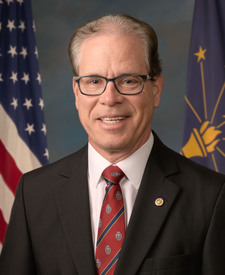
Mike Braun
AnalysisR IN · Senate
Healthcare
-24Government Operations
-10Finance
-17Environment
+13Education
-28Transportation
-38Regulated Industries
-56Defense
+7Healthcare Consumers
-112Foreign Policy
-6Housing
-10Criminal Justice
-15Energy
-25Agriculture
-1Taxation
0Environmental Groups
-41Trade
-1Veterans Affairs
0National Security
-19Labor
-2Industry Impact Profile
2426 industry impacts
How this is computed
P Primary sponsor · C Co-sponsor · Y Yea vote · N Nay vote
Weighted score (w:) uses strongest role per bill. Weights: Primary 1.0, Co-sponsor 0.3, Yea 0.1, Nay -0.1.
Bills where the legislator voted nay (without sponsorship) contribute -0.1 per bill. Equal yea and nay roll calls on the same bill contribute 0.
Vote date filters affect vote attribution; sponsorship is always included.
Positive-Effect Industries
Negative-Effect Industries
Click any row to see supporting clauses
Showing positive and negative-direction effects only. Mixed and uncertain effects are not included in these counts.
Sponsored & Cosponsored Bills
sres500-118
CosponsorDesignating November 8, 2023, as National First-Generation College Celebration Day.
s219-118
Primary SponsorTo provide that Members of Congress may not receive pay after October 1 of any fiscal year in which Congress has not approved a concurrent resolution on the budget and passed the regular appropriations bills.
sres603-118
Primary SponsorDesignating April 2024 as National Native Plant Month.
sres256-118
CosponsorRecognizing Father's Day and the role of father engagement in improving the overall health and life outcomes for both the mother and baby.
sres436-118
CosponsorExpressing support for the designation of the week of October 24, 2023, to October 31, 2023, as BatWeek.
sres605-118
CosponsorRecognizing the 75th anniversary of the National Institute of Dental and Craniofacial Research and its critical role in improving the dental, oral, and craniofacial health of the United States through research, training, and the dissemination of health information.
sres221-118
CosponsorPromoting minority health awareness and supporting the goals and ideals of National Minority Health Month in April 2023, which include bringing attention to the health disparities faced by minority populations of the United States such as American Indians, Alaska Natives, Asian Americans, African Americans, Hispanics, and Native Hawaiians or other Pacific Islanders.
sres62-118
Primary SponsorRecognizing the Little Sisters of the Poor of Indianapolis on its 150th Anniversary.
sres102-118
Primary SponsorObserving the 100th anniversary of the birth of John Leslie Wes Montgomery and commemorating his contributions to jazz music.
s532-118
CosponsorTo preserve and protect the free choice of individual employees to form, join, or assist labor organizations, or to refrain from such activities.
sres292-118
Primary SponsorCongratulating the Fighting Irish of the University of Notre Dame men’s lacrosse team for winning the 2023 National Collegiate Athletic Association Division I Men's Lacrosse National Championship.
sres67-118
CosponsorSupporting the goals and ideals of Career and Technical Education Month.
sres645-118
CosponsorDesignating the week of April 20 through April 28, 2024, as National Park Week.
s5475-118
Primary Sponsor IntroducedTo amend the Organic Foods Production Act of 1990 to provide producers with the option to confirm the absence of prohibited substances through testing, and for other purposes.
sres925-118
CosponsorRelating to the death of the Honorable Fred R. Harris, former Senator for the State of Oklahoma.
s5452-118
Cosponsor IntroducedTo designate the facility of the United States Postal Service located at 119 North Anderson Street in Elwood, Indiana, as the Officer Noah Jacob Shahnavaz Post Office Building.
sres918-118
Cosponsor In CommitteeDesignating December 2, 2024, as World Nuclear Energy Day.
sres908-118
Cosponsor In CommitteeExpressing support for the goals of Stomach Cancer Awareness Month.
sres913-118
CosponsorSupporting the goals and ideals of a National Move Over Law Day.
sres914-118
CosponsorExpressing support for the goals of National Adoption Day and National Adoption Month by promoting national awareness of adoption and the children awaiting families, celebrating children and families involved in adoption, and encouraging the people of the United States to secure safety, permanency, and well-being for all children.
Loading countries...
Select a clause to see detailed analysis
Failed to load analysis
Please try again
Failed to load clauses
Please try again
Click an industry from the Impact Profile to view supporting clauses
Select a clause to see detailed analysis