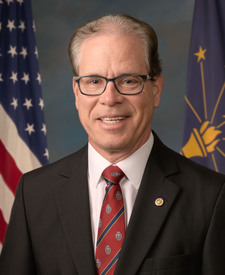
Mike Braun
AnalysisR IN · Senate
Healthcare
-24Government Operations
-10Finance
-17Environment
+13Education
-28Transportation
-38Regulated Industries
-56Defense
+7Healthcare Consumers
-112Foreign Policy
-6Housing
-10Criminal Justice
-15Energy
-25Agriculture
-1Taxation
0Environmental Groups
-41Trade
-1Veterans Affairs
0National Security
-19Labor
-2Industry Impact Profile
2426 industry impacts
How this is computed
P Primary sponsor · C Co-sponsor · Y Yea vote · N Nay vote
Weighted score (w:) uses strongest role per bill. Weights: Primary 1.0, Co-sponsor 0.3, Yea 0.1, Nay -0.1.
Bills where the legislator voted nay (without sponsorship) contribute -0.1 per bill. Equal yea and nay roll calls on the same bill contribute 0.
Vote date filters affect vote attribution; sponsorship is always included.
Positive-Effect Industries
Negative-Effect Industries
Click any row to see supporting clauses
Showing positive and negative-direction effects only. Mixed and uncertain effects are not included in these counts.
Sponsored & Cosponsored Bills
s5257-118
Cosponsor IntroducedTo amend the Camp Lejeune Justice Act of 2022 to make technical corrections.
sres869-118
Cosponsor In CommitteeDesignating the week beginning November 11, 2024, as National Pregnancy Center Week to recognize the vital role that community-supported pregnancy centers play in saving lives and serving women and men faced with difficult pregnancy decisions.
s4661-118
Primary Sponsor IntroducedTo amend title 31, United States Code, to include information on improper payments under Federal programs, and for other purposes.
s4577-118
Primary Sponsor IntroducedTo amend the Older Americans Act of 1965 to require the Assistant Secretary for Aging to publish on an online portal information on national resource centers authorized or supported under such Act, and for other purposes.
s4528-118
Primary Sponsor IntroducedTo award posthumously a Congressional Gold Medal to Marshall Walter Major Taylor in recognition of his significance to the nation as an athlete, trailblazer, role model, and equal rights advocate.
s4485-118
Cosponsor IntroducedTo amend chapter 8 of title 5, United States Code, to provide for en bloc consideration in resolutions of disapproval for midnight rules, and for other purposes.
sres712-118
CosponsorDesignating May 2024 as Older Americans Month.
sres669-118
Cosponsor In CommitteeDesignating October 10, 2024, as American Girls in Sports Day.
sres636-118
CosponsorDesignating February 29, 2024, as Rare Disease Day.
s4082-118
Primary Sponsor IntroducedTo amend the Tariff Act of 1930 to increase accountability relating to articles receiving exemptions from duties for de minimis entries and to require regulations on enhanced data collection with respect to such entries, and for other purposes.
s4051-118
Cosponsor IntroducedTo prohibit transportation of any alien using certain methods of identification, and for other purposes.
s4034-118
Cosponsor IntroducedTo withhold certain United Nations funding until the United Nations Human Rights Council mandates a body to investigate human rights abuses in the People's Republic of China, and for other purposes.
s3812-118
Cosponsor IntroducedTo provide firearm licensees an opportunity to correct statutory and regulatory violations, and for other purposes.
sres549-118
CosponsorExpressing support for the designation of February 17 through February 24, 2024, as National FFA Week, recognizing the important role of the National FFA Organization in developing the next generation of globally conscious leaders who will change the world, and celebrating the 10th anniversary of the Give the Gift of Blue program, which has donated more than 17,000 of the iconic FFA blue jackets to FFA members in need.
s3777-118
Cosponsor IntroducedTo require Congress to budget in advance for disasters, and for other purposes.
s3659-118
Cosponsor IntroducedTo require a citizenship question on the decennial census, to require reporting on certain census statistics, and to modify apportionment of Representatives to be based on United States citizens instead of all persons.
s3611-118
Cosponsor IntroducedTo amend part A of title IV of the Social Security Act to clarify the longstanding authority of States to use funds made available under the Temporary Assistance for Needy Families program to fund life-affirming services to empower pregnant women to choose life for their babies instead of abortion, and for other purposes.
s3454-118
Cosponsor IntroducedTo prohibit the use of Federal funds to purchase at-home tests for SARS–CoV–2 from certain foreign entities.
s3413-118
Cosponsor IntroducedTo reinstate pilots fired or forced to resign because of a COVID–19 vaccine mandate.
s3344-118
Cosponsor IntroducedTo ensure that organizations with religious or moral convictions are allowed to continue to provide services for children.
Loading countries...
Select a clause to see detailed analysis
Failed to load analysis
Please try again
Failed to load clauses
Please try again
Click an industry from the Impact Profile to view supporting clauses
Select a clause to see detailed analysis