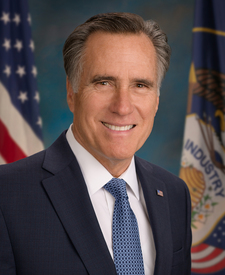
Mitt Romney
AnalysisR UT · Senate
Healthcare
+17Government Operations
-5Foreign Policy
-24Defense
+13Transportation
+15Environment
+35Finance
-4Education
+1Trade
+13Energy
+1Science & Space
+2Technology
+1Labor
-1Regulated Industries
-2Housing
+12Electric Utilities
-20Criminal Justice
+8Native American Tribes
-11National Security
+1Foreign Affairs
-6Industry Impact Profile
807 industry impacts
How this is computed
P Primary sponsor · C Co-sponsor · Y Yea vote · N Nay vote
Weighted score (w:) uses strongest role per bill. Weights: Primary 1.0, Co-sponsor 0.3, Yea 0.1, Nay -0.1.
Bills where the legislator voted nay (without sponsorship) contribute -0.1 per bill. Equal yea and nay roll calls on the same bill contribute 0.
Vote date filters affect vote attribution; sponsorship is always included.
Positive-Effect Industries
Click any row to see supporting clauses
Showing positive and negative-direction effects only. Mixed and uncertain effects are not included in these counts.
Sponsored & Cosponsored Bills
s5403-118
Primary Sponsor IntroducedTo align the United States International Development Finance Corporation with United States national security and strategic goals.
s5131-118
Cosponsor IntroducedTo advance a competitive strategy against the People’s Republic of China, and for other purposes.
s4026-118
Primary Sponsor IntroducedTo require a report on the state of economic integration between the United States and the People's Republic of China and the risks of that integration to the national security of the United States.
s2355-118
Cosponsor IntroducedTo clarify the applicability of sanctions and antimoney laundering compliance obligations to United States persons in the decentralized finance technology sector and virtual currency kiosk operators, and for other purposes.
s2333-118
Cosponsor ReportedTo reauthorize certain programs under the Public Health Service Act with respect to public health security and all-hazards preparedness and response, and for other purposes.
s2017-118
Primary Sponsor IntroducedTo provide multiyear procurement authority for LGM–35A Sentinel intercontinental ballistic missiles, and for other purposes.
s2031-118
Primary Sponsor IntroducedTo strengthen the national security of the United States by decreasing the reliance of the Department of Defense on critical minerals from the People’s Republic of China, the Russian Federation, the Islamic Republic of Iran, the Democratic People’s Republic of North Korea, and other geostrategic competitors and adversaries of the United States, and for other purposes.
s1871-118
Cosponsor ReportedTo create intergovernmental coordination between State, local, Tribal, and territorial jurisdictions, and the Federal Government to combat United States reliance on the People’s Republic of China and other covered countries for critical minerals and rare earth metals, and for other purposes.
s1349-118
Cosponsor IntroducedTo establish a postsecondary student data system.
s804-118
Cosponsor IntroducedTo provide for security in the Black Sea region, and for other purposes.
s824-118
Cosponsor ReportedTo require the Secretary of Homeland Security to establish a national risk management cycle, and for other purposes.
s686-118
Cosponsor IntroducedTo authorize the Secretary of Commerce to review and prohibit certain transactions between persons in the United States and foreign adversaries, and for other purposes.
s473-118
Cosponsor IntroducedTo provide for drone security.
Loading countries...
Select a clause to see detailed analysis
Failed to load analysis
Please try again
Failed to load clauses
Please try again
Click an industry from the Impact Profile to view supporting clauses
Select a clause to see detailed analysis