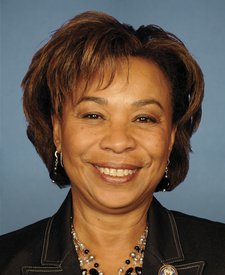
Barbara Lee
AnalysisD CA-12 · House
Healthcare
+92Education
-82Government Operations
0Environment
+46Finance
-56Transportation
+28Civil Rights
+18Agriculture
-61Energy
+11Defense
+16Labor
+20National Security
-128Regulated Industries
-62Housing
+33Criminal Justice
+6Social Welfare
+111Foreign Policy
-7Business
-61Healthcare Consumers
-72Immigration
-1Industry Impact Profile
4157 industry impacts
How this is computed
P Primary sponsor · C Co-sponsor · Y Yea vote · N Nay vote
Weighted score (w:) uses strongest role per bill. Weights: Primary 1.0, Co-sponsor 0.3, Yea 0.1, Nay -0.1.
Bills where the legislator voted nay (without sponsorship) contribute -0.1 per bill. Equal yea and nay roll calls on the same bill contribute 0.
Vote date filters affect vote attribution; sponsorship is always included.
Positive-Effect Industries
Click any row to see supporting clauses
Showing positive and negative-direction effects only. Mixed and uncertain effects are not included in these counts.
Sponsored & Cosponsored Bills
hres1552-118
Cosponsor In CommitteeExpressing support for the recognition of October 26, 2024, as Intersex Awareness Day, and supporting the goals and ideals of Intersex Awareness Day.
hres1553-118
Cosponsor In CommitteeExpressing the sense that the House of Representatives must take responsible and timely action to address the Federal tax loophole that allows Act 22 decree holders to legally evade Federal taxes.
hr10028-118
Cosponsor IntroducedTo amend the Internal Revenue Code of 1986 to disallow the deduction of certain expenses relating to ownership of single-family homes by specified large investors, to impose an excise tax on the sale of such homes by such investors, and to prohibit Federal mortgage assistance relating to certain large investors.
hr9998-118
Cosponsor IntroducedTo require the Secretary of Transportation to issue a final rule setting minimum structural standards for railroad bridges, and for other purposes.
hr9977-118
Primary Sponsor IntroducedTo direct the Administrator of the United States Agency for International Development, the Secretary of Health and Human Services, and the Secretary of Veterans Affairs to provide assistance for individuals affected by exposure to Agent Orange, and for other purposes.
hr9985-118
Cosponsor IntroducedTo subject certain private funds to joint and several liability with respect to the liabilities of firms acquired and controlled by those funds, and for other purposes.
hr9983-118
Cosponsor IntroducedTo establish a grant program to support the conservation and preservation of historic military ships and submarines, and for other purposes.
hr9973-118
Cosponsor IntroducedTo require the public disclosure of COINTELPRO records, to establish a COINTELPRO Records Collection, and to establish the COINTELPRO Records Review Board, and for other purposes.
hres1534-118
Cosponsor In CommitteeRecognizing the 15th anniversary of Outdoor Afro.
hr9931-118
Cosponsor IntroducedTo provide bankruptcy relief for student borrowers.
hr9907-118
Cosponsor IntroducedTo provide for a comprehensive Federal response to Long COVID, including research, education, and support for affected individuals, to direct the National Institutes of Health to establish a Long COVID research program, and for other purposes.
hres1530-118
Cosponsor In CommitteeRecognizing the life, achievements, and public service of former President James Earl Jimmy Carter, Jr., on the occasion of his 100th birthday.
hr9878-118
Cosponsor IntroducedTo amend the Richard B. Russell National School Lunch Act to require mandatory certification for certain students and reduce stigma associated with unpaid school meal fees, and for other purposes.
hr9862-118
Cosponsor IntroducedTo amend the Internal Revenue Code of 1986 to allow for the reallocation of unused volume cap for private activity bonds for qualified residential rental projects.
hr9875-118
Cosponsor IntroducedTo establish an independent Children’s Commission and position of Commissioner, and for other purposes.
hr9873-118
Cosponsor IntroducedTo amend the Fair Labor Standards Act of 1938 and the Internal Revenue Code of 1986 to make certain modifications in relation to the minimum wage.
hr9838-118
Cosponsor IntroducedTo amend the Internal Revenue Code of 1986 to provide for an end date for the credit for certain qualified carbon oxide, and for other purposes.
hr9794-118
Cosponsor IntroducedTo amend the Food Security Act of 1985 to direct the Secretary of Agriculture to provide grants to producers to carry out climate-smart conversion projects, and for other purposes.
hr8057-118
Cosponsor ReportedTo designate the facility of the United States Postal Service located at 9317 Bolsa Avenue in Westminster, California, as the Little Saigon Vietnam War Veterans Memorial Post Office.
hr9855-118
Cosponsor IntroducedTo amend title 38, United States Code, to modify authorities relating to the collective bargaining of employees in the Veterans Health Administration.
Loading countries...
Select a clause to see detailed analysis
Failed to load analysis
Please try again
Failed to load clauses
Please try again
Click an industry from the Impact Profile to view supporting clauses
Select a clause to see detailed analysis