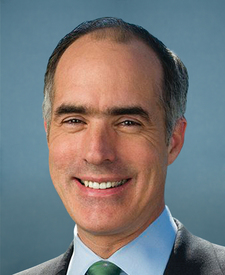
Robert P. Casey, Jr.
AnalysisD PA · Senate
Healthcare
+150Government Operations
-18Education
-20Transportation
-37Finance
-10Environment
+25Labor
+30Defense
+2Criminal Justice
-10Elections
-9Native American Tribes
-77Technology
-10Civil Rights
+9Trade
-16Regulated Industries
-37Foreign Policy
-6Housing
-4Immigration
-5Energy
0Science & Space
+29Industry Impact Profile
3289 industry impacts
How this is computed
P Primary sponsor · C Co-sponsor · Y Yea vote · N Nay vote
Weighted score (w:) uses strongest role per bill. Weights: Primary 1.0, Co-sponsor 0.3, Yea 0.1, Nay -0.1.
Bills where the legislator voted nay (without sponsorship) contribute -0.1 per bill. Equal yea and nay roll calls on the same bill contribute 0.
Vote date filters affect vote attribution; sponsorship is always included.
Positive-Effect Industries
Negative-Effect Industries
Click any row to see supporting clauses
Showing positive and negative-direction effects only. Mixed and uncertain effects are not included in these counts.
Sponsored & Cosponsored Bills
s5070-118
Primary Sponsor IntroducedTo amend title XIX of the Social Security Act to remove certain age restrictions on Medicaid eligibility for working adults with disabilities.
sres822-118
Cosponsor In CommitteeDesignating September 2024 as National Voting Rights Month.
sres823-118
CosponsorRecognizing Hispanic Heritage Month and celebrating the heritage and culture of Latinos in the United States and the immense contributions of Latinos to the United States.
sres817-118
CosponsorDesignating the week beginning September 8, 2024, as National Direct Support Professionals Recognition Week.
s5034-118
Cosponsor IntroducedTo provide additional benefits to American workers whose employment has been impacted as a result of the transition to a clean energy economy.
sres812-118
Cosponsor In CommitteeSupporting the designation of September 20, 2024, as National Concussion Awareness Day.
s5033-118
Cosponsor IntroducedTo amend the Child Care Access Means Parents In School Program under the Higher Education Act of 1965.
sres815-118
Cosponsor In CommitteeDesignating the week beginning on September 9, 2024, as National Hispanic-Serving Institutions Week.
s5026-118
Cosponsor IntroducedTo establish programs to reduce rates of sepsis.
s5016-118
Primary Sponsor IntroducedTo combat the economic aggression of the People's Republic of China, and for other purposes.
s4923-118
Primary Sponsor IntroducedTo amend title IV of the Social Security Act to require States to provide information about available benefits and services to kinship caregivers.
s4956-118
Cosponsor IntroducedTo regulate electronic medical device use in secure compartmented information facilities, to require the Director of the National Intelligence oversee transparency reporting and related initiatives, to encourage investment in modernization efforts for sensitive compartmented information facilities, and for other purposes.
s4973-118
Cosponsor IntroducedTo reassert the constitutional authority of Congress to determine the general applicability of the criminal laws of the United States, and for other purposes.
s4954-118
Primary Sponsor IntroducedTo require the Secretary of Transportation to issue a final rule setting minimum structural standards for railroad bridges, and for other purposes.
sres800-118
CosponsorCondemning the attempted assassination of former President Donald J. Trump during a political rally in Butler, Pennsylvania, honoring the victims who were killed and injured at the rally, and calling for unity and civility in the United States.
s4909-118
Primary Sponsor IntroducedTo clarify the use of direct deposit for contributions to ABLE programs.
s4911-118
Primary Sponsor IntroducedTo amend the Internal Revenue Code to allow employers to contribute to ABLE accounts in lieu of retirement plan contributions.
s4910-118
Primary Sponsor IntroducedTo direct Federal agencies to provide information on ABLE accounts and to provide grants for increasing awareness of ABLE accounts.
s4891-118
Primary Sponsor IntroducedTo amend title 10, United States Code, to direct the Secretary of Defense to limit copayments for outpatient visits for mental health or behavioral health under the TRICARE program, and for other purposes.
s4860-118
Primary Sponsor IntroducedTo amend title XVIII of the Social Security Act to establish coverage for certain residential substance use disorder services under the Medicare program.
Loading countries...
Select a clause to see detailed analysis
Failed to load analysis
Please try again
Failed to load clauses
Please try again
Click an industry from the Impact Profile to view supporting clauses
Select a clause to see detailed analysis