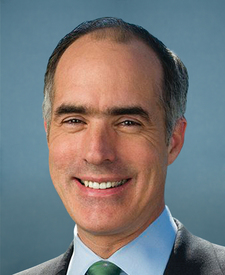
Robert P. Casey, Jr.
AnalysisD PA · Senate
Healthcare
+150Government Operations
-18Education
-20Transportation
-37Finance
-10Environment
+25Labor
+30Defense
+2Criminal Justice
-10Elections
-9Native American Tribes
-77Technology
-10Civil Rights
+9Trade
-16Regulated Industries
-37Foreign Policy
-6Housing
-4Immigration
-5Energy
0Science & Space
+29Industry Impact Profile
3289 industry impacts
How this is computed
P Primary sponsor · C Co-sponsor · Y Yea vote · N Nay vote
Weighted score (w:) uses strongest role per bill. Weights: Primary 1.0, Co-sponsor 0.3, Yea 0.1, Nay -0.1.
Bills where the legislator voted nay (without sponsorship) contribute -0.1 per bill. Equal yea and nay roll calls on the same bill contribute 0.
Vote date filters affect vote attribution; sponsorship is always included.
Positive-Effect Industries
Negative-Effect Industries
Click any row to see supporting clauses
Showing positive and negative-direction effects only. Mixed and uncertain effects are not included in these counts.
Sponsored & Cosponsored Bills
s5238-118
Cosponsor IntroducedTo amend title 49, United States Code, to prohibit Amtrak from including mandatory arbitration clauses in contracts of carriage, and for other purposes.
s5266-118
Primary Sponsor IntroducedTo require automatic sealing of certain criminal records, and for other purposes.
sres888-118
CosponsorHonoring the life of James Ralph Sasser, former Senator for the State of Tennessee.
s5194-118
Cosponsor IntroducedTo amend the Internal Revenue Code of 1986 to expand eligibility for the refundable credit for coverage under a qualified health plan.
s5180-118
Cosponsor IntroducedTo amend subtitle A of title XX of the Social Security Act to fund additional projects that focus on competency-based training for personal or home care aides, and for other purposes.
s5208-118
Cosponsor IntroducedTo establish protections for warehouse workers, and for other purposes.
s5199-118
Primary Sponsor IntroducedTo reauthorize the National Flood Insurance Program, and for other purposes.
s5236-118
Cosponsor IntroducedTo amend titles XIX and XXI of the Social Security Act to enhance financial support for rural and safety net hospitals providing maternity, labor, and delivery services to vulnerable populations, and for other purposes.
sres880-118
CosponsorSupporting afterschool programs and Lights On Afterschool, a national celebration of afterschool programs held on October 24, 2024.
sres845-118
Cosponsor In CommitteeExpressing support for the recognition of September 23, 2024, to September 29, 2024, as Asian American and Native American Pacific Islander-Serving Institutions Week.
sres848-118
CosponsorDesignating the week of September 23 through September 27, 2024, as National Hazing Awareness Week.
sres838-118
CosponsorExpressing support for the designation of November 17, 2024, as National Warrior Call Day and recognizing the importance of connecting warriors in the United States to support structures necessary to transition from the battlefield, especially peer-to-peer connection.
sres841-118
CosponsorDesignating September 2024 as National Childhood Cancer Awareness Month.
s5123-118
Primary Sponsor IntroducedTo amend the Trade Act of 1974 to modify the eligibility requirements for the Generalized System of Preferences to strengthen worker protections and to ensure that beneficiary developing countries afford equal rights and protection under the law, regardless of gender, and for other purposes.
s5132-118
Cosponsor IntroducedTo promote the economic security and safety of survivors of domestic violence, dating violence, sexual assault, or stalking, and for other purposes.
s5128-118
Primary Sponsor IntroducedTo require the Director of the Bureau of Prisons to develop and implement a strategy to interdict illicit substances and other contraband in the mail at Federal correctional facilities.
s5094-118
Primary Sponsor IntroducedTo amend the Emergency Food Assistance Act of 1983 to provide additional agricultural products for distribution by emergency feeding organizations, and for other purposes.
sres828-118
Cosponsor In CommitteeExpressing the sense of the Senate that every person has the basic right to emergency health care, including abortion care.
sres825-118
Cosponsor In CommitteeRecognizing the significance of equal pay and the pay disparity between disabled women and both disabled and nondisabled men.
s5101-118
Primary Sponsor IntroducedTo amend the Soil and Water Resources Conservation Act of 1977 with respect to assessments of conservation programs, and for other purposes.
Loading countries...
Select a clause to see detailed analysis
Failed to load analysis
Please try again
Failed to load clauses
Please try again
Click an industry from the Impact Profile to view supporting clauses
Select a clause to see detailed analysis