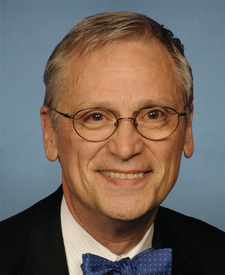
Earl Blumenauer
AnalysisD OR-3 · House
Healthcare
+38Environment
+27Education
-101Government Operations
+1Agriculture
-131Finance
+11Energy
-21Civil Rights
+19Regulated Industries
-74Transportation
+18National Security
-128Housing
+54Native American Tribes
-111Criminal Justice
+11Defense
+23Labor
+12Foreign Policy
-6Healthcare Consumers
-37Science & Space
+22Business
-33Industry Impact Profile
3470 industry impacts
How this is computed
P Primary sponsor · C Co-sponsor · Y Yea vote · N Nay vote
Weighted score (w:) uses strongest role per bill. Weights: Primary 1.0, Co-sponsor 0.3, Yea 0.1, Nay -0.1.
Bills where the legislator voted nay (without sponsorship) contribute -0.1 per bill. Equal yea and nay roll calls on the same bill contribute 0.
Vote date filters affect vote attribution; sponsorship is always included.
Positive-Effect Industries
Negative-Effect Industries
Click any row to see supporting clauses
Showing positive and negative-direction effects only. Mixed and uncertain effects are not included in these counts.
Sponsored & Cosponsored Bills
hr10314-118
Cosponsor IntroducedTo amend the Internal Revenue Code of 1986 to establish a National Resilience and Recovery Fund, and for other purposes.
hr8732-118
Cosponsor IntroducedTo enhance the rights of domestic employees, and for other purposes.
hr8525-118
Cosponsor IntroducedTo hold law enforcement accountable for misconduct in court, improve transparency through data collection, and reform police training and policies.
hr8323-118
Cosponsor IntroducedTo provide emergency assistance to States, territories, Tribal nations, and local areas affected by substance use disorder, including the use of opioids and stimulants, and to make financial assistance available to States, territories, Tribal nations, local areas, public or private nonprofit entities, and certain health providers, to provide for the development, organization, coordination, and operation of more effective and cost efficient systems for the delivery of essential services to individuals with substance use disorder and their families.
hr7782-118
Cosponsor IntroducedTo provide economic empowerment opportunities in the United States through the modernization of public housing, and for other purposes.
hr6747-118
Cosponsor IntroducedTo speed up the deployment of electricity transmission and clean energy, with proper input from affected communities, and for other purposes.
hr6673-118
Cosponsor IntroducedTo amend the Controlled Substances Act to provide for a new rule regarding the application of the Act to marijuana, and for other purposes.
hr6570-118
Cosponsor ReportedTo amend the Foreign Intelligence Surveillance Act of 1978 to reform certain authorities and to provide greater transparency and oversight.
hr6515-118
Primary Sponsor IntroducedTo combat illegal deforestation by prohibiting the importation of products made wholly or in part of certain commodities produced on land undergoing illegal deforestation, and for other purposes.
hr6416-118
Cosponsor IntroducedTo amend the Internal Revenue Code of 1986 to impose certain tax penalties in connection with the invasion of Ukraine.
hres753-118
Cosponsor In CommitteeCommemorating the fifth anniversary of the murder of Jamal Khashoggi and calling for accountability.
hr5592-118
Cosponsor IntroducedTo prohibit the use of Federal funds from preventing a State from implementing their own laws with respect to psilocybin.
hr5294-118
Cosponsor IntroducedTo remove barriers to the ability of unhoused individuals to register to vote and vote in elections for Federal office, and for other purposes.
hr5013-118
Cosponsor IntroducedTo direct the Secretary of Health and Human Services to revise certain regulations in relation to the Medicare shared savings program and other alternative payment arrangements to encourage participation in such program, and for other purposes.
hr5048-118
Cosponsor IntroducedTo protect our democracy by preventing abuses of Presidential power, restoring checks and balances and accountability and transparency in government, and defending elections against foreign interference, and for other purposes.
hr4987-118
Cosponsor IntroducedTo secure the Federal voting rights of persons when released from incarceration.
hr4260-118
Cosponsor IntroducedTo amend title II of the Social Security Act to provide an equitable Social Security formula for individuals with noncovered employment and to provide relief for individuals currently affected by the Windfall Elimination Provision.
hres519-118
Cosponsor In CommitteeRecognizing that the United States has a moral obligation to meet its foundational promise of guaranteed justice for all.
hr4121-118
Cosponsor IntroducedTo protect an individual’s ability to access contraceptives and to engage in contraception and to protect a health care provider’s ability to provide contraceptives, contraception, and information related to contraception.
hr4004-118
Cosponsor ReportedTo approve and implement the Agreement between the American Institute in Taiwan and the Taipei Economic and Cultural Representative Office in the United States regarding Trade between the United States of America and Taiwan, and for other purposes.
Loading countries...
Select a clause to see detailed analysis
Failed to load analysis
Please try again
Failed to load clauses
Please try again
Click an industry from the Impact Profile to view supporting clauses
Select a clause to see detailed analysis