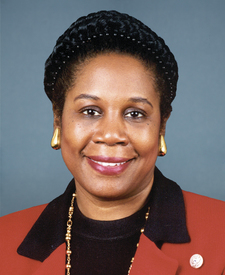
Sheila Jackson Lee
AnalysisD TX-18 · House
Healthcare
+38Education
-118Government Operations
-4Environment
-5Criminal Justice
-8Finance
0Transportation
-9Labor
+11Defense
+1Regulated Industries
-35Civil Rights
-12Energy
-14Agriculture
-23Housing
+13Environmental Groups
-41Native American Tribes
-46Immigration
-1Foreign Policy
-1Business
-20Veterans
-33Industry Impact Profile
1844 industry impacts
How this is computed
P Primary sponsor · C Co-sponsor · Y Yea vote · N Nay vote
Weighted score (w:) uses strongest role per bill. Weights: Primary 1.0, Co-sponsor 0.3, Yea 0.1, Nay -0.1.
Bills where the legislator voted nay (without sponsorship) contribute -0.1 per bill. Equal yea and nay roll calls on the same bill contribute 0.
Vote date filters affect vote attribution; sponsorship is always included.
Positive-Effect Industries
Negative-Effect Industries
Click any row to see supporting clauses
Showing positive and negative-direction effects only. Mixed and uncertain effects are not included in these counts.
Sponsored & Cosponsored Bills
hr8980-118
Cosponsor IntroducedTo authorize the Attorney General to provide grants to States, units of local government, and organizations to support the recruitment, training, and development of staff and infrastructure needed to support the due process rights of individuals facing deportation.
hr8825-118
Cosponsor IntroducedTo protect the right to vote in elections for Federal office, and for other purposes.
hr8732-118
Cosponsor IntroducedTo enhance the rights of domestic employees, and for other purposes.
hr8525-118
Primary Sponsor IntroducedTo hold law enforcement accountable for misconduct in court, improve transparency through data collection, and reform police training and policies.
hr8323-118
Cosponsor IntroducedTo provide emergency assistance to States, territories, Tribal nations, and local areas affected by substance use disorder, including the use of opioids and stimulants, and to make financial assistance available to States, territories, Tribal nations, local areas, public or private nonprofit entities, and certain health providers, to provide for the development, organization, coordination, and operation of more effective and cost efficient systems for the delivery of essential services to individuals with substance use disorder and their families.
hr7905-118
Cosponsor IntroducedTo prohibit States from imposing a tax on the retail sale of menstrual products.
hr7137-118
Cosponsor ReportedTo provide for the vacating of certain convictions and expungement of certain arrests of victims of human trafficking.
hr6092-118
Cosponsor IntroducedTo regulate law enforcement use of facial recognition technology, and for other purposes.
hr5810-118
Cosponsor IntroducedTo provide back pay to Federal contractors, and for other purposes.
hr5800-118
Primary Sponsor IntroducedTo authorize the imposition of sanctions to combat the mass abduction of Ukrainian children to Russia and areas of Ukraine that are temporarily occupied by Russian forces, and for other purposes.
hres702-118
Cosponsor In CommitteeRecognizing the duty of the Federal Government to protect the rights of restaurant workers.
hr5294-118
Cosponsor IntroducedTo remove barriers to the ability of unhoused individuals to register to vote and vote in elections for Federal office, and for other purposes.
hr4987-118
Cosponsor IntroducedTo secure the Federal voting rights of persons when released from incarceration.
hres627-118
Cosponsor In CommitteeCondemning the Government of the Islamic Republic of Iran for the massacre of political prisoners in 1988 and the uprisings of recent years, including the 2018, 2019, and 2022 uprisings, and calling for justice for its victims.
hr5048-118
Cosponsor IntroducedTo protect our democracy by preventing abuses of Presidential power, restoring checks and balances and accountability and transparency in government, and defending elections against foreign interference, and for other purposes.
hres519-118
Cosponsor In CommitteeRecognizing that the United States has a moral obligation to meet its foundational promise of guaranteed justice for all.
hr4121-118
Cosponsor IntroducedTo protect an individual’s ability to access contraceptives and to engage in contraception and to protect a health care provider’s ability to provide contraceptives, contraception, and information related to contraception.
hr3421-118
Cosponsor IntroducedTo establish an improved Medicare for All national health insurance program.
hr3305-118
Cosponsor IntroducedTo end preventable maternal mortality, severe maternal morbidity, and maternal health disparities in the United States, and for other purposes.
hr3352-118
Cosponsor IntroducedTo amend the Internal Revenue Code of 1986 to treat diapers as qualified medical expenses; and to prohibit States and local governments to impose a tax on the retail sale of diapers.
Loading countries...
Select a clause to see detailed analysis
Failed to load analysis
Please try again
Failed to load clauses
Please try again
Click an industry from the Impact Profile to view supporting clauses
Select a clause to see detailed analysis