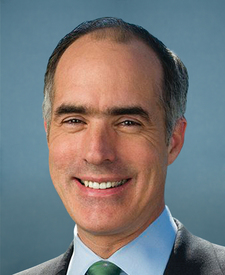
Robert P. Casey, Jr.
AnalysisD PA · Senate
Healthcare
+150Government Operations
-18Education
-20Transportation
-37Finance
-10Environment
+25Labor
+30Defense
+2Criminal Justice
-10Elections
-9Native American Tribes
-77Technology
-10Civil Rights
+9Trade
-16Regulated Industries
-37Foreign Policy
-6Housing
-4Immigration
-5Energy
0Science & Space
+29Industry Impact Profile
3289 industry impacts
How this is computed
P Primary sponsor · C Co-sponsor · Y Yea vote · N Nay vote
Weighted score (w:) uses strongest role per bill. Weights: Primary 1.0, Co-sponsor 0.3, Yea 0.1, Nay -0.1.
Bills where the legislator voted nay (without sponsorship) contribute -0.1 per bill. Equal yea and nay roll calls on the same bill contribute 0.
Vote date filters affect vote attribution; sponsorship is always included.
Positive-Effect Industries
Negative-Effect Industries
Click any row to see supporting clauses
Showing positive and negative-direction effects only. Mixed and uncertain effects are not included in these counts.
Sponsored & Cosponsored Bills
s4474-118
Primary Sponsor IntroducedTo amend the Juvenile Justice and Delinquency Prevention Act of 1974 to eliminate the use of valid court orders to secure lockup of status offenders, and for other purposes.
s4613-118
Cosponsor IntroducedTo amend the Older Americans Act of 1965 to establish the Office of LGBTQI Inclusion and a rural outreach grant program, and for other purposes.
sres749-118
Cosponsor In CommitteeRecognizing June 2024, as LGBTQ Pride Month.
s4595-118
Cosponsor IntroducedTo improve the structure of the Federal Pell Grant program, and for other purposes.
s4629-118
Cosponsor IntroducedTo prohibit discrimination on the basis of religion, sex (including sexual orientation and gender identity), and marital status in the administration and provision of child welfare services, to improve safety, well-being, and permanency for lesbian, gay, bisexual, transgender, and queer or questioning foster youth, and for other purposes.
sres744-118
Cosponsor In CommitteeExpressing support for the designation of June 28, 2024, as “Stonewall Day”.
s4578-118
Cosponsor IntroducedTo amend the Older Americans Act of 1965 to require reports to Congress on State Long-Term Care Ombudsman Programs, and for other purposes.
s4583-118
Primary Sponsor IntroducedTo amend the Federal Food, Drug, and Cosmetic Act to extend the authority of the Secretary of Health and Human Services to issue priority review vouchers to encourage treatments for rare pediatric diseases.
s4582-118
Cosponsor IntroducedTo reauthorize the trade adjustment assistance program.
sres740-118
Cosponsor In CommitteeAcknowledging and apologizing for the mistreatment of, and discrimination against, lesbian, gay, bisexual, and transgender individuals who served the United States in the uniformed services, the Foreign Service, and the Federal civil service.
s4539-118
Cosponsor IntroducedTo amend the Internal Revenue Code of 1986 to make certain provisions with respect to qualified ABLE programs permanent.
s4552-118
Cosponsor IntroducedTo enhance the rights of domestic employees, and for other purposes.
s4532-118
Cosponsor IntroducedTo amend title XVIII of the Social Security Act to establish requirements with respect to the use of prior authorization under Medicare Advantage plans.
s4541-118
Cosponsor IntroducedTo amend the Internal Revenue Code of 1986 to make certain provisions with respect to qualified ABLE programs permanent.
s4523-118
Cosponsor IntroducedTo amend the Richard B. Russell National School Lunch Act to expand community eligibility, and for other purposes.
s4525-118
Primary Sponsor IntroducedTo amend the Richard B. Russell National School Lunch Act to improve program requirements, and for other purposes.
s4502-118
Cosponsor IntroducedTo prohibit forced arbitration in work disputes, and for other purposes.
sres723-118
CosponsorCelebrating 40 years of Universal Design for Learning.
sres716-118
Cosponsor In CommitteeExpressing support for the designation of June 7, 2024, as National Gun Violence Awareness Day and June 2024 as National Gun Violence Awareness Month.
s4445-118
Cosponsor IntroducedTo protect and expand nationwide access to fertility treatment, including in vitro fertilization.
Loading countries...
Select a clause to see detailed analysis
Failed to load analysis
Please try again
Failed to load clauses
Please try again
Click an industry from the Impact Profile to view supporting clauses
Select a clause to see detailed analysis