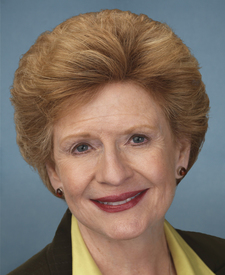
Debbie Stabenow
AnalysisD MI · Senate
Healthcare
+56Education
+7Agriculture
+188Government Operations
-21Finance
+14Environment
+46Labor
+32Elections
-9Transportation
-8Criminal Justice
-1Energy
+21Civil Rights
+1Foreign Policy
-9Regulated Industries
-36Healthcare Consumers
-47Immigration
-19Defense
-3Native American Tribes
-42Trade
+20Technology
+14Industry Impact Profile
2972 industry impacts
How this is computed
P Primary sponsor · C Co-sponsor · Y Yea vote · N Nay vote
Weighted score (w:) uses strongest role per bill. Weights: Primary 1.0, Co-sponsor 0.3, Yea 0.1, Nay -0.1.
Bills where the legislator voted nay (without sponsorship) contribute -0.1 per bill. Equal yea and nay roll calls on the same bill contribute 0.
Vote date filters affect vote attribution; sponsorship is always included.
Positive-Effect Industries
Negative-Effect Industries
Click any row to see supporting clauses
Showing positive and negative-direction effects only. Mixed and uncertain effects are not included in these counts.
Sponsored & Cosponsored Bills
sres645-118
CosponsorDesignating the week of April 20 through April 28, 2024, as National Park Week.
sres83-118
CosponsorDesignating the week of February 6 through 10, 2023, as National School Counseling Week.
sres548-118
CosponsorDesignating the week of February 5 through 9, 2024, as National School Counseling Week.
s758-118
CosponsorTo amend the Tariff Act of 1930 to protect personally identifiable information, and for other purposes.
s5474-118
Cosponsor IntroducedTo amend title XI of the Social Security Act to establish an interagency council on social determinants of health, and for other purposes.
sres925-118
CosponsorRelating to the death of the Honorable Fred R. Harris, former Senator for the State of Oklahoma.
s5428-118
Cosponsor IntroducedTo provide women with increased access to preventive and life-saving cancer screening.
s5418-118
Cosponsor IntroducedTo amend the Public Health Service Act to authorize grants for training and support services for families and caregivers of people living with Alzheimer's disease or a related dementia.
sres902-118
CosponsorRelating to the death of Timothy Peter Johnson, former Senator for the State of South Dakota.
sres878-118
CosponsorHonoring the life, legacy, and contributions of James Earl Jones.
sres861-118
Cosponsor In CommitteeExpressing support for the designation of September 2024 as Sickle Cell Disease Awareness Month in order to educate communities across the United States about sickle cell disease and the need for research, early detection methods, effective treatments, and preventative care programs with respect to complications from sickle cell disease and conditions related to sickle cell disease.
s5236-118
Cosponsor IntroducedTo amend titles XIX and XXI of the Social Security Act to enhance financial support for rural and safety net hospitals providing maternity, labor, and delivery services to vulnerable populations, and for other purposes.
sres887-118
CosponsorExpressing support for the designation of October 7 through October 12, 2024, as National 4–H Week.
sres888-118
CosponsorHonoring the life of James Ralph Sasser, former Senator for the State of Tennessee.
s5227-118
Cosponsor IntroducedTo reaffirm and clarify the Federal relationships of the Grand River Bands of Ottawa Indians of Michigan as a federally recognized Indian tribe, and for other purposes.
s5194-118
Cosponsor IntroducedTo amend the Internal Revenue Code of 1986 to expand eligibility for the refundable credit for coverage under a qualified health plan.
sres847-118
CosponsorHonoring Wadee Alfayoumi, a 6-year-old Palestinian-American boy, murdered as a victim of a hate crime for his Palestinian-Muslim identity, in the State of Illinois.
sres845-118
Cosponsor In CommitteeExpressing support for the recognition of September 23, 2024, to September 29, 2024, as Asian American and Native American Pacific Islander-Serving Institutions Week.
sres842-118
CosponsorDesignating the week beginning October 20, 2024, as National Character Counts Week.
s5138-118
Cosponsor IntroducedTo amend title 38, United States Code, to modify the criteria for approval of certain independent study programs for purposes of the educational assistance programs of the Department of Veterans Affairs.
Loading countries...
Select a clause to see detailed analysis
Failed to load analysis
Please try again
Failed to load clauses
Please try again
Click an industry from the Impact Profile to view supporting clauses
Select a clause to see detailed analysis