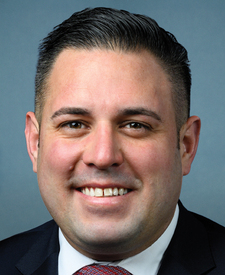
Anthony D’Esposito
AnalysisR NY-4 · House
Defense
+6Government Operations
+9Education
+6Healthcare
+4Criminal Justice
-27Immigration
+1Environment
-1Transportation
-1Finance
+1Civil Rights
-6Veterans
-24Foreign Policy
-2Housing
+7Energy
0Trade
-13Veterans Affairs
0Technology
+2Native American Tribes
-10Law Enforcement
+9Culture
0Industry Impact Profile
848 industry impacts
How this is computed
P Primary sponsor · C Co-sponsor · Y Yea vote · N Nay vote
Weighted score (w:) uses strongest role per bill. Weights: Primary 1.0, Co-sponsor 0.3, Yea 0.1, Nay -0.1.
Bills where the legislator voted nay (without sponsorship) contribute -0.1 per bill. Equal yea and nay roll calls on the same bill contribute 0.
Vote date filters affect vote attribution; sponsorship is always included.
Negative-Effect Industries
Click any row to see supporting clauses
Showing positive and negative-direction effects only. Mixed and uncertain effects are not included in these counts.
Sponsored & Cosponsored Bills
hr9701-118
Cosponsor IntroducedTo provide for the reallocation of certain grant funds from jurisdictions that do not allow for consideration the danger, risk, or threat an individual poses to the community when determining bail or pretrial release or that have in effect a policy providing for the sealing of certain criminal records.
hres1226-118
Cosponsor In CommitteeResolution memorializing law enforcement officers killed in the line of duty.
hr8146-118
Primary Sponsor ReportedTo require a report by the Attorney General on the impact the border crisis is having on law enforcement at the Federal, State, local, and Tribal level.
hr7581-118
Cosponsor Passed HouseTo require the Attorney General to develop reports relating to violent attacks against law enforcement officers, and for other purposes.
hr5798-118
Cosponsor ReportedTo restore the right to negotiate matters pertaining to the discipline of law enforcement officers of the District of Columbia through collective bargaining, to restore the statute of limitations for bringing disciplinary cases against members or civilian employees of the Metropolitan Police Department of the District of Columbia, and for other purposes.
hr4384-118
Cosponsor IntroducedTo reauthorize the Project Safe Neighborhoods Grant Program Authorization Act of 2018, and for other purposes.
hr3148-118
Cosponsor IntroducedTo provide grants to State, local, territorial, and Tribal law enforcement agencies to purchase chemical screening devices and train personnel to use chemical screening devices in order to enhance law enforcement efficiency and protect law enforcement officers.
hres363-118
Cosponsor Passed HouseExpressing support for recognizing National Police Week.
hr3091-118
Cosponsor ReportedTo allow Federal law enforcement officers to purchase retired service weapons, and for other purposes.
hr3079-118
Cosponsor IntroducedTo protect law enforcement officers, and for other purposes.
hres330-118
Primary Sponsor In CommitteeSupporting the designation of the week of April 23 through April 29, 2023, as National Crime Victims’ Rights Week.
hr2794-118
Cosponsor ReportedTo secure the international borders of the United States, and for other purposes.
hres285-118
Primary Sponsor In CommitteeEstablishing a Bill of Rights to support United States law enforcement personnel nationwide in their work to protect our communities.
hr2494-118
Cosponsor Passed HouseTo make the assault of a law enforcement officer a deportable offense, and for other purposes.
hres69-118
Cosponsor In CommitteeExpressing the sense of the House of Representatives that the dedication and devotion of law enforcement personnel should be recognized and that calls to defund, disband, dismantle, or abolish the police should be condemned.
hr467-118
Cosponsor Passed HouseTo amend the Controlled Substances Act with respect to the scheduling of fentanyl-related substances, and for other purposes.
hr304-118
Cosponsor IntroducedTo authorize grants for States, and units of local government that take efforts to stop enabling repeat violence, and for other purposes.
Loading countries...
Select a clause to see detailed analysis
Failed to load analysis
Please try again
Failed to load clauses
Please try again
Click an industry from the Impact Profile to view supporting clauses
Select a clause to see detailed analysis