To authorize the President to enter into trade agreements for the reciprocal elimination of duties or other import restrictions with respect to medical goods to contribute to the national security and public health of the United States, and for other purposes.
Analysis under review: This bill has generated analysis that may be too generic or incomplete. Clause-level evidence remains available below.
Summary
This bill creates a framework for the President to negotiate trade agreements with trusted partner countries to reduce or eliminate tariffs and trade barriers on medical supplies, drugs, and devices. The bill responds to COVID-19 supply chain vulnerabilities, noting that over 30% of U.S. medical imports came from China. Partner countries must demonstrate commitment to open trade during health emergencies, intellectual property protection, and good regulatory practices. The bill includes extensive Congressional oversight requirements including 60-day advance notice before negotiations, consultation requirements, and mandatory reports. The U.S. Trade Representative must monitor partner compliance and can recommend suspension of agreements for non-compliance.
Evidence Chain:
This summary is generated from the full bill text using AI analysis. Expand "Detailed Analysis" below for identified beneficiaries/burden bearers.
At a Glance
What This Bill Does
Authorizes the President to negotiate trusted trade partner agreements with allied countries for the reciprocal elimination of duties and trade barriers on medical goods (devices, pharmaceuticals, and inputs) to diversify U.S. medical supply chains away from adversarial dependence and improve pandemic preparedness.
Who Benefits
- U.S. medical device and pharmaceutical importers
- Allied countries medical goods manufacturers
- U.S. healthcare providers and patients (supply chain resilience)
Who Bears Costs
- Domestic medical goods manufacturers (increased import competition from partners)
- Countries excluded from trusted partner status (competitive disadvantage)
- China-based medical supply chain participants
Key Policy Areas
{'domain': 'Trade', 'evidence': 'Authorizes President to negotiate, enter, and enforce trusted trade partner agreements eliminating duties, quotas, and trade barriers on medical goods'}, {'domain': 'Healthcare', 'evidence': 'Targets medical devices, pharmaceutical goods, and inputs; aims to secure reliable medical supply chains for pandemic response'}, {'domain': 'National Security', 'evidence': 'Findings cite national security risks from concentration of medical supply imports from China (30.6%) and non-diversified import partners'}
Primary Purpose
Authorizes the President to negotiate trusted trade partner agreements with allied countries for the reciprocal elimination of duties and trade barriers on medical goods (devices, pharmaceuticals, and inputs) to diversify U.S. medical supply chains away from adversarial dependence and improve pandemic preparedness.
Policy Domains
Legislative Strategy
"Uses trade liberalization with allied countries as a supply chain diversification tool, with extensive Congressional guardrails to prevent unilateral executive action and ensure transparency"
Sponsors
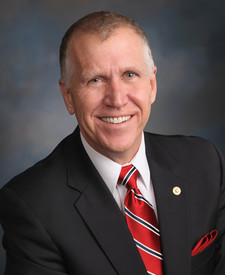
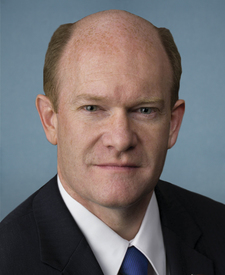
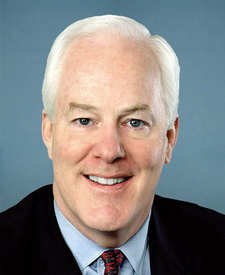

Legislative Progress
IntroducedMr. Tillis (for himself, Mr. Coons, Mr. Cornyn, and Mr. …
Stakeholder Effects
cui bono?How this legislation distributes effects. Mention counts reflect frequency, not effect magnitude.
Allied countries medical goods manufacturers, Domestic medical goods manufacturers, Medical device manufacturers
Positive-direction: Allied countries medical goods manufacturers, Medical goods importers from trusted partner countries, U.S. healthcare providers, U.S. medical goods supply chain
Negative-direction: Domestic medical goods manufacturers
Congressional trade committees, United States Trade Representative
Positive-direction: Congressional trade committees
Negative-direction: United States Trade Representative
Countries excluded from trusted partner status, Trusted trade partner countries
Bill Structure & Actor Mappings
Who is "The Secretary" in each section?
- "the_president"
- → President of the United States
- "trade_representative"
- → United States Trade Representative
- "itc"
- → International Trade Commission
- "the_president"
- → President
- "trade_representative"
- → USTR
- "the_president"
- → President
- "trade_representative"
- → USTR
Key Definitions
Terms defined in this bill
Any foreign country or territory, including overseas dependent territories, or Trust Territory of Pacific Islands
A device as defined under 21 USC 321 intended for use in humans
Any medical device, pharmaceutical good, or input for such a device or good
A drug as defined under 21 USC 321 intended for use in humans
Any country that has entered into an agreement with the United States under section 5
We use a combination of our own taxonomy and classification in addition to large language models to assess meaning and potential beneficiaries. High confidence means strong textual evidence. Always verify with the original bill text.
Learn more about our methodology