To establish a Green New Deal for public schools.
Analysis under review: This bill has generated analysis that may be too generic or incomplete. Clause-level evidence remains available below.
Summary
What This Bill Does
The Green New Deal for Public Schools Act creates a massive federal investment program to transform public schools into climate-resilient, healthy, zero-carbon buildings while dramatically increasing education funding. It appropriates $44 billion annually for special education (IDEA) and $74 billion annually for Title I schools over 10 years, and establishes grant programs for school retrofits and climate resiliency.
Who Benefits and How
Public school districts receive substantial new federal funding for staffing, facilities, and equity programs. Construction and green building industries benefit from billions in school retrofit contracts for renewable energy, air quality improvements, and electrification projects. Teachers and paraprofessionals gain from expanded hiring and career pathway programs. Special education services receive full federal funding commitment.
Who Bears the Burden and How
Federal taxpayers bear the cost of approximately $118 billion in annual mandatory appropriations plus additional discretionary spending. School districts must complete extensive planning processes and community engagement requirements to access grants. State education agencies must administer new grant programs and submit compliance reports.
Key Provisions
- Appropriates $44 billion/year for IDEA special education and $74 billion/year for Title I schools for 10 years
- Creates climate capital facilities grants to convert schools to healthy zero-carbon buildings
- Establishes Climate Change Resiliency Program enabling schools to serve as community emergency centers
- Funds resource block grants for hiring educators, support staff, and community partnerships
Evidence Chain:
This summary is generated from the full bill text using AI analysis. Expand "Detailed Analysis" below for identified beneficiaries/burden bearers.
At a Glance
What This Bill Does
Establishes massive federal investments in public school infrastructure, climate resiliency, educational equity, and special education funding through a Green New Deal framework.
Key Policy Areas
Education, Environment, Climate Change, Infrastructure, Labor
Primary Purpose
Establishes massive federal investments in public school infrastructure, climate resiliency, educational equity, and special education funding through a Green New Deal framework.
Policy Domains
Title I - Sustainable Schools
Identified Gains
Contextual inference, no direct clause citation- Public school districts
- Construction industry
- Green building contractors
- Teachers and paraprofessionals
- Students with disabilities
- Low-income students
Contextual inference, no direct clause citation
Identified Costs
Contextual inference, no direct clause citation- Federal taxpayers
- School districts (administrative requirements)
Contextual inference, no direct clause citation
Title II - Climate Change Resiliency
Identified Gains
Contextual inference, no direct clause citation- Public schools
- Local communities
- Construction industry
- Renewable energy companies
- Labor unions and apprenticeship programs
Contextual inference, no direct clause citation
Identified Costs
Contextual inference, no direct clause citation- Federal taxpayers
- State education agencies (administration)
Contextual inference, no direct clause citation
Sponsors
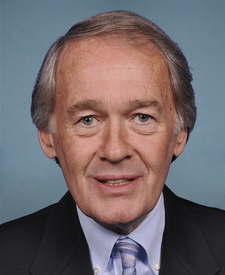

Legislative Progress
IntroducedMr. Markey (for himself and Mr. Sanders) introduced the following …
Stakeholder Effects
cui bono?How this legislation distributes effects. Mention counts reflect frequency, not effect magnitude.
Bureau of Indian Education schools and tribally controlled schools, Local educational agencies, Local educational agencies (planning requirements)
Positive-direction: Local educational agencies, Local educational agency consortia, Paraprofessionals and school support staff, Public school districts, Public schools and BIE schools, Public schools for climate resiliency, Special education programs and services, Students with disabilities, Teachers and educators, Title I schools serving low-income students
Negative-direction: Local educational agencies (planning requirements), Local educational agencies applying for grants
Local communities in disaster-prone areas, Low-income students and families, Taxpayers
Positive-direction: Local communities in disaster-prone areas, Low-income students and families
Negative-direction: Taxpayers
Construction contractors, Green building and construction contractors
Renewable energy and energy storage companies, Renewable energy equipment manufacturers and installers
HVAC and air quality systems contractors
Bill Structure & Actor Mappings
Who is "The Secretary" in each section?
- "the_secretary"
- → Secretary of Education
- "secretary_of_energy"
- → Secretary of Energy
- "the_secretary"
- → Secretary of Education
Key Definitions
Terms defined in this bill
Schools and dormitories operated by the Bureau of Indian Education, or pursuant to grants under the Tribally Controlled Schools Act or contracts under the Indian Self-Determination and Education Assistance Act
Holistic modification of a facility to remove health harms, eliminate greenhouse gas emissions, and ensure a safe, accessible, and comfortable environment
A public school with highly energy-efficient facilities that produce no greenhouse gas emissions from on-site energy use
We use a combination of our own taxonomy and classification in addition to large language models to assess meaning and potential beneficiaries. High confidence means strong textual evidence. Always verify with the original bill text.
Learn more about our methodology