Spectrum Pipeline Act of 2025
Summary
What This Bill Does
The Spectrum Pipeline Act of 2025 creates a multi-year pipeline for reallocating federal and shared spectrum. The NTIA Assistant Secretary, in consultation with the FCC, must identify at least 2,500 megahertz in the 1.3 GHz to 13.2 GHz covered band for non-federal use, shared federal and non-federal use, or both, including at least 1,250 megahertz for full-power commercial licensed wireless broadband. The first 1,250 megahertz must be identified within two years, and the remaining amount within five years. For commercial licensed use, the FCC must complete auctions for at least 1,250 megahertz, including at least 600 megahertz within three years and the rest within six years. The FCC must make at least 125 megahertz available for unlicensed use within two years and make any remaining identified spectrum available for licensed or unlicensed use within eight years. The bill extends general FCC auction authority to September 30, 2027 and extends covered-band authority for eight years after enactment. NTIA must report to Congress when spectrum is identified and one year after enactment on federal and non-federal operations, candidate bands, presidential steps to withdraw or modify federal assignments, relocation or sharing cost estimates, and global harmonization. Section 3 modernizes the Spectrum Relocation Fund by shortening several review periods from 30 or 60 days to 15 days and allowing costs for state-of-the-art replacement systems when that replacement enables reallocation of significantly more valuable spectrum from federal to non-federal or shared use.
Who Benefits and How
Wireless broadband carriers benefit from a required pipeline of full-power commercial licensed spectrum and FCC auctions. Mobile broadband consumers benefit if more mid-band spectrum improves capacity, coverage, and competition. Unlicensed spectrum users benefit from at least 125 megahertz made available for unlicensed use. FCC auction staff and congressional commerce committees benefit from clearer authority, deadlines, and reporting. Federal agencies can benefit from state-of-the-art replacement systems when relocation enables more valuable reallocation.
Who Bears the Burden and How
NTIA spectrum managers and FCC auction staff must identify, coordinate, report, auction, and open spectrum on fixed deadlines. Federal spectrum users in the covered band may have to relocate, share, or modify operations. The President must begin withdrawal or modification of federal assignments as necessary for auctions. Spectrum Relocation Fund administrators must review modified timelines and replacement-system cost claims. Federal taxpayers and auction proceeds are exposed to relocation or sharing costs even though auctions may generate offsetting revenue.
Key Provisions
- Requires identification of at least 2,500 megahertz in the 1.3 to 13.2 GHz band, including 1,250 megahertz for full-power commercial licensed use.
- Requires FCC auctions for at least 1,250 megahertz, including 600 megahertz within three years and the balance within six years.
- Requires at least 125 megahertz for unlicensed use within two years and use of remaining identified spectrum within eight years.
- Extends FCC auction authority to September 30, 2027 and covered-band authority for eight years.
- Requires progress, identification, operations, relocation-cost, presidential-action, and global-harmonization reports to Congress.
- Modernizes Spectrum Relocation Fund deadlines and eligible state-of-the-art replacement-system costs.
Evidence Chain:
This summary is generated from the full bill text using AI analysis. Expand "Detailed Analysis" below for identified beneficiaries/burden bearers with clause-level evidence links.
At a Glance
What This Bill Does
Requires NTIA and FCC to identify at least 2,500 megahertz between 1.3 and 13.2 GHz for reallocation, auction at least 1,250 megahertz for full-power commercial licensed wireless use, make at least 125 megahertz available for unlicensed use, extend auction authority, require congressional reports, and modernize Spectrum Relocation Fund timing and eligible replacement-system costs.
Key Policy Areas
Telecommunications, Technology, Government
Primary Purpose
Requires NTIA and FCC to identify at least 2,500 megahertz between 1.3 and 13.2 GHz for reallocation, auction at least 1,250 megahertz for full-power commercial licensed wireless use, make at least 125 megahertz available for unlicensed use, extend auction authority, require congressional reports, and modernize Spectrum Relocation Fund timing and eligible replacement-system costs.
Policy Domains
Substantive provisions
Identified Gains
- Wireless broadband carriers
- Mobile broadband consumers
- Unlicensed spectrum users
- FCC auction staff
- Congressional commerce committees
- Federal agencies replacing spectrum systems
Identified Costs
- NTIA spectrum managers
- FCC auction staff
- Federal spectrum users
- President of the United States
- Spectrum Relocation Fund administrators
- Federal taxpayers
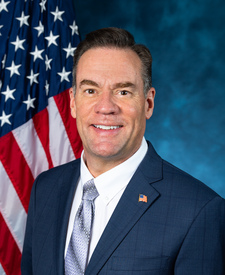
Sponsors

Legislative Progress
In CommitteeMr. Allen introduced the following bill; which was referred to …
Referred to the House Committee on Energy and Commerce.
Introduced in House
Stakeholder Effects
cui bono?How this legislation distributes effects. Mention counts reflect frequency, not effect magnitude.
Congressional commerce committees, FCC auction staff, Federal agencies relocating spectrum systems
Positive-direction: Congressional commerce committees
Negative-direction: FCC auction staff, Federal agencies relocating spectrum systems, Federal spectrum users, NTIA relocation fund administrators, NTIA spectrum managers
Wireless broadband carriers, Wireless broadband licensees
Bill Structure & Actor Mappings
Who is "The Secretary" in each section?
We use a combination of our own taxonomy and classification in addition to large language models to assess meaning and potential beneficiaries. High confidence means strong textual evidence. Always verify with the original bill text.
Learn more about our methodology