High-skilled Immigration Reform for Employment Act
Summary
What This Bill Does
The High-skilled Immigration Reform for Employment Act amends the Immigration and Nationality Act by increasing the regular H-1B cap from 65,000 to 130,000 and removing language that capped advanced-degree exemptions after 20,000 exempted workers. It also updates H-1B-dependent employer thresholds: employers with 50 or fewer full-time-equivalent employees become dependent at 50 H-1B workers rather than 25, employers with 51 to 100 employees become dependent at 24 H-1B workers rather than 12, and larger employers are measured from 101 employees rather than 51. The bill separately creates the Promoting American Ingenuity Grant Program, allowing the Education Secretary to make competitive grants to States to strengthen elementary, secondary, and higher education in science, mathematics, engineering, and technology, retain K-12 STEM teachers, and support higher-education STEM programs, with $25 million authorized for each fiscal year 2026 through 2030.
Who Benefits and How
H-1B employers and high-skilled foreign workers benefit from a larger regular cap and removal of the 20,000 advanced-degree exemption ceiling. Some employers benefit because the H-1B-dependent threshold rises, reducing dependent-employer obligations. States, K-12 schools, STEM teachers, and colleges benefit from competitive STEM education grants.
Who Bears the Burden and How
U.S. workers competing in H-1B-heavy occupations may face more labor-market competition. USCIS and Labor Department systems must administer higher caps and revised dependency thresholds. The Education Department must run a new competitive STEM grant program, and Federal taxpayers bear the $25 million annual authorization.
Key Provisions
- Increases the H-1B regular cap from 65,000 to 130,000.
- Removes the 20,000 cap on advanced-degree H-1B exemptions.
- Raises H-1B-dependent employer thresholds for smaller, medium, and larger employers.
- Creates a competitive State STEM education grant program covering K-12 and higher education.
- Authorizes $25 million per year for fiscal years 2026 through 2030 for the grant program.
Evidence Chain:
This summary is generated from the full bill text using AI analysis. Expand "Detailed Analysis" below for identified beneficiaries/burden bearers with clause-level evidence links.
At a Glance
What This Bill Does
Doubles the H-1B regular cap, raises H-1B-dependent employer thresholds, removes the 20,000 limit on advanced-degree exemptions, and creates a $25 million-per-year STEM education grant program for States.
Key Policy Areas
Immigration, Labor, Education
Primary Purpose
Doubles the H-1B regular cap, raises H-1B-dependent employer thresholds, removes the 20,000 limit on advanced-degree exemptions, and creates a $25 million-per-year STEM education grant program for States.
Policy Domains
Substantive provisions
Identified Gains
- H-1B employers
- High-skilled foreign workers
- State education agencies
- STEM teachers
- Institutions of higher education
Identified Costs
- U.S. workers competing in H-1B-heavy occupations
- U.S. Citizenship and Immigration Services
- Department of Labor
- Department of Education
- Federal taxpayers
Sponsors


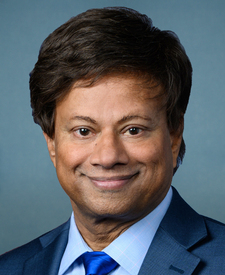
Legislative Progress
In CommitteeMr. Krishnamoorthi (for himself, Mrs. McIver, and Mr. Thanedar) introduced …
Referred to the Committee on Education and Workforce, and in …
Introduced in House
Stakeholder Effects
cui bono?How this legislation distributes effects. Mention counts reflect frequency, not effect magnitude.
Department of Education, Department of Labor, U.S. Citizenship and Immigration Services
Institutions of higher education, STEM teachers, State education agencies
Bill Structure & Actor Mappings
Who is "The Secretary" in each section?
We use a combination of our own taxonomy and classification in addition to large language models to assess meaning and potential beneficiaries. High confidence means strong textual evidence. Always verify with the original bill text.
Learn more about our methodology